


Rethinking AI Justice and Ownership: Simba Kaneunyenye Reflections from the JUST AI Conference

Artificial intelligence is often described as the future: efficient, objective, and capable of solving complex societal problems. Yet Simba Kaneunyenye’s reflections from the JUST AI Conference offered a more critical perspective: before embracing AI, societies must ask who builds it, who controls it, and who benefits from it.
The Risks of Unquestioned AI Adoption
In reflecting on these issues, Simba recalled the science fiction film Minority Report. He shared how the story, centred on a system that predicts crimes before they happen, once seemed futuristic but now feels increasingly relevant. What appeared to be a flawless justice system in the film eventually exposed deep flaws when it turned against one of its own supporters. For Simba, the lesson was clear: systems presented as neutral or unquestionable can still produce injustice.
He noted that this fictional premise is no longer distant imagination. Across the world, AI tools are now being used in policing, border control, surveillance, and immigration systems to identify so-called “high-risk” individuals. These technologies increasingly influence who is monitored, who is trusted, and who is excluded.
As a criminology scholar, Simba shared that such developments are especially concerning in African contexts, where policing histories are closely tied to colonial control and the targeting of marginalised communities. He explained that these legacies do not disappear when technology is introduced. Instead, they risk being absorbed into datasets and reproduced through algorithms.
During the conference organised by Research ICT Africa, Simba presented his paper titled Resisting the Poisoned Chalice: Rethinking the Global South’s Adoption of Artificial Intelligence in Policing and Immigration Control. He shared that the paper challenges the assumption that data-driven systems are naturally fair. Instead, it argues that when historical bias shapes data, AI can automate and legitimise existing inequalities.
Reclaiming Ownership and Shaping Africa’s AI Future
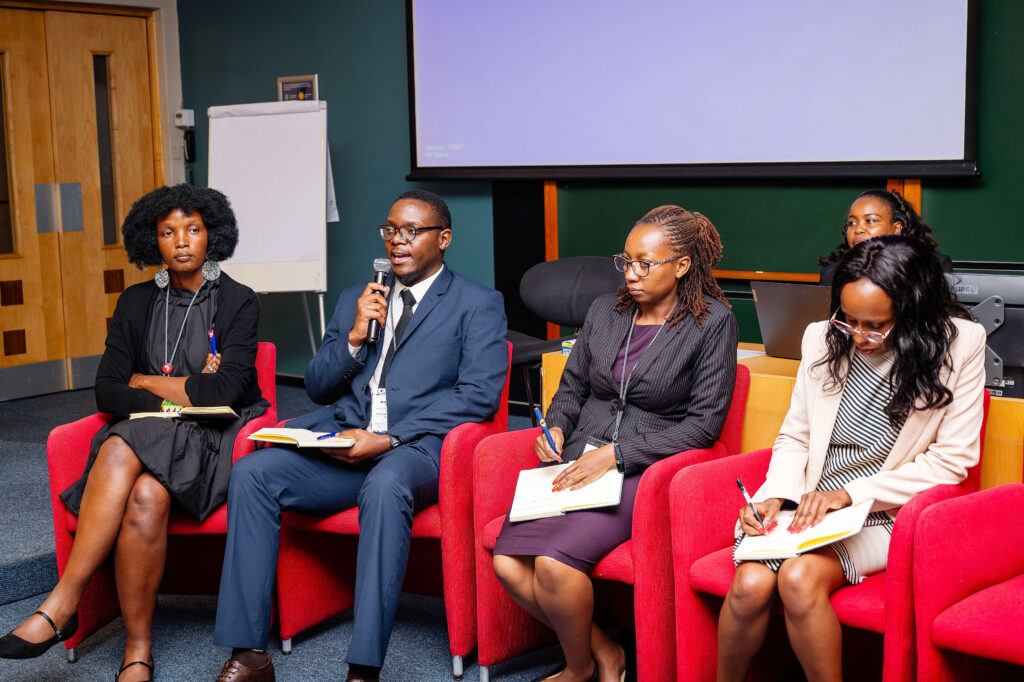
Beyond the risks, Simba also reflected on the powerful ideas emerging throughout the two-day gathering in Johannesburg. Across discussions, one recurring theme stood out strongly to him: ownership.
He shared insights raised by Dr Angella Ndaka, who argued that justice in AI goes far beyond inclusion or ethical principles. Simba recalled her emphasis that justice is about “who owns the infrastructure, who controls the data, who sets the rules and who benefits from value creation”. For him, this reframed the AI debate entirely, from passive adoption to active self-determination.
What inspired him most was the breadth of innovation already taking place across Africa. Simba highlighted the work of researchers preserving African languages in AI systems, recognising that language carries culture, history, and identity. He also reflected on conversations around national health and biometric datasets being used in global negotiations, raising urgent questions about sovereignty and unregulated cross-border data flows.
These discussions, he shared, have influenced how he approaches his own work as both a researcher and an Umholi weAfrica fellow placed at the Zimbabwe Human Rights Commission.
Simba reflected that AI now sits at a defining crossroads: it can either reinforce long-standing inequalities or become a tool for fairer and more inclusive governance. The responsibility, he noted, is to create safeguards against the former while intentionally designing for the latter.
Looking ahead, he shared his intention to deepen his research, not only exposing the risks of unregulated AI in crime prevention but also identifying practical pathways for responsible and context-sensitive use.
His reflections offered an important reminder: the real question is not whether Africa will use AI, but whether Africa will shape it on its own terms.
 Africa Career Networks
  English
  French
  Portuguese
  Arabic
Laisser un commentaire
Vous devez vous connecter pour publier un commentaire.